The most expensive domain names ever sold include voice.com ($30M), insurance.com ($35.6M), and cars.com (part of a $872M company acquisition). They share three traits: single dictionary words, .com extension, and the ability to define an entire market category. That said, most successful businesses - Stripe, Notion, Figma - built their brands on creative, affordable domains. Great businesses make great domains, not the other way around.

What are the most expensive domain names ever sold?
Here are the landmark sales that defined the premium domain market, with the story behind each price tag.
voice.com - $30,000,000 (2019)
MicroStrategy sold voice.com to Block.one, the blockchain company behind the EOS network. Block.one planned to launch a social media platform called Voice - a blockchain-based alternative to Twitter and Facebook where users would own their content and data.
Why it was worth $30M:
- Single, universally understood English word
- Relevant across technology, communication, and media
- .com extension with zero ambiguity
- Block.one had raised $4B in its EOS ICO - $30M was a rounding error for a flagship brand
What happened: Voice launched in 2021 but struggled to gain traction. The domain remains one of the most expensive ever sold regardless of the platform's commercial outcome - a reminder that domain value and business success are separate questions.
insurance.com - $35,600,000 (2010)
QuinStreet, a performance marketing company, purchased insurance.com for $35.6M. At the time, it was the highest publicly reported domain sale ever.
Why it was worth $35.6M:
- "Insurance" is one of the highest-value keywords in Google Ads - a single click can be worth $50–$80
- The domain captures organic search traffic that would otherwise cost millions per year in paid advertising
- Category-defining: anyone searching "insurance" is a qualified buyer
What happened: QuinStreet operates it as a lead generation site, connecting consumers with insurance providers. The SEO value alone - replacing or reducing paid search spend - made the economics defensible. At $35.6M with millions in annual organic traffic, the payback period was measurable in years, not decades.
cars.com - $872,000,000 (acquisition context, 2017)
While cars.com itself wasn't sold in isolation for that figure, the company built around the domain was acquired for $872M. The domain was central to the brand's valuation - it ranked for virtually every high-intent car-buying search term without paid advertising.
Why it commanded that value:
- Direct navigation traffic: people type "cars.com" into browsers without searching
- Category ownership: no competitor could rank higher for "cars" organically
- The domain was the moat - not the technology, not the team
sex.com - $13,000,000 (2010)
Sold for $13M, sex.com holds the record for the most litigated domain in internet history. It was stolen from its original owner Gary Kremen in the 1990s via a forged letter to Network Solutions, triggering a decade-long legal battle that shaped US domain law.
Why it was valuable: Pure search volume. The word generates billions of queries annually with direct commercial intent across multiple revenue models.
fund.com - $9,999,950 (2008)
Sold for just under $10M to a financial services company. Single-word financial domain names command premiums because the audience is high-value and the search intent is clear.
Other notable sales
| Domain | Sale Price | Year |
|---|---|---|
| business.com | $7.5M | 1999 |
| diamond.com | $7.5M | 2006 |
| beer.com | $7M | 2004 |
| slots.com | $5.5M | 2010 |
| toys.com | $5.1M | 2009 |
| porno.com | $8.8M | 2015 |
| crypto.com | $12M | 2018 |
Source: NameBio domain sales history and DN Journal
Why are single-word .com domains worth millions?

Several converging factors make single-word .com domains disproportionately valuable:
1. Finite supply There are roughly 170,000 common English words. Most single-word .com domains were registered in the 1990s. You cannot create more of them. Scarcity plus demand equals price.
2. SEO and direct navigation A domain matching a search term gets a mild relevance signal from Google. More importantly, it attracts direct navigation traffic - users who type the domain directly - and it builds trust instantly with visitors.
3. No explanation required insurance.com tells you everything. A brand built on insurance.com requires zero advertising to communicate its purpose. That clarity has economic value: lower customer acquisition cost, higher conversion rates, better recall.
4. Defensive value Owning cars.com means competitors cannot. For a market leader, preventing a competitor from owning the category name is worth paying for independently of any traffic benefit.
5. .com dominance The .com extension holds ~48% of all registered domains and commands significant trust advantages. Most premium sales are .com - alternatives like .net or .io trade at fractions of equivalent .com prices.
Does .com always dominate premium domain sales?
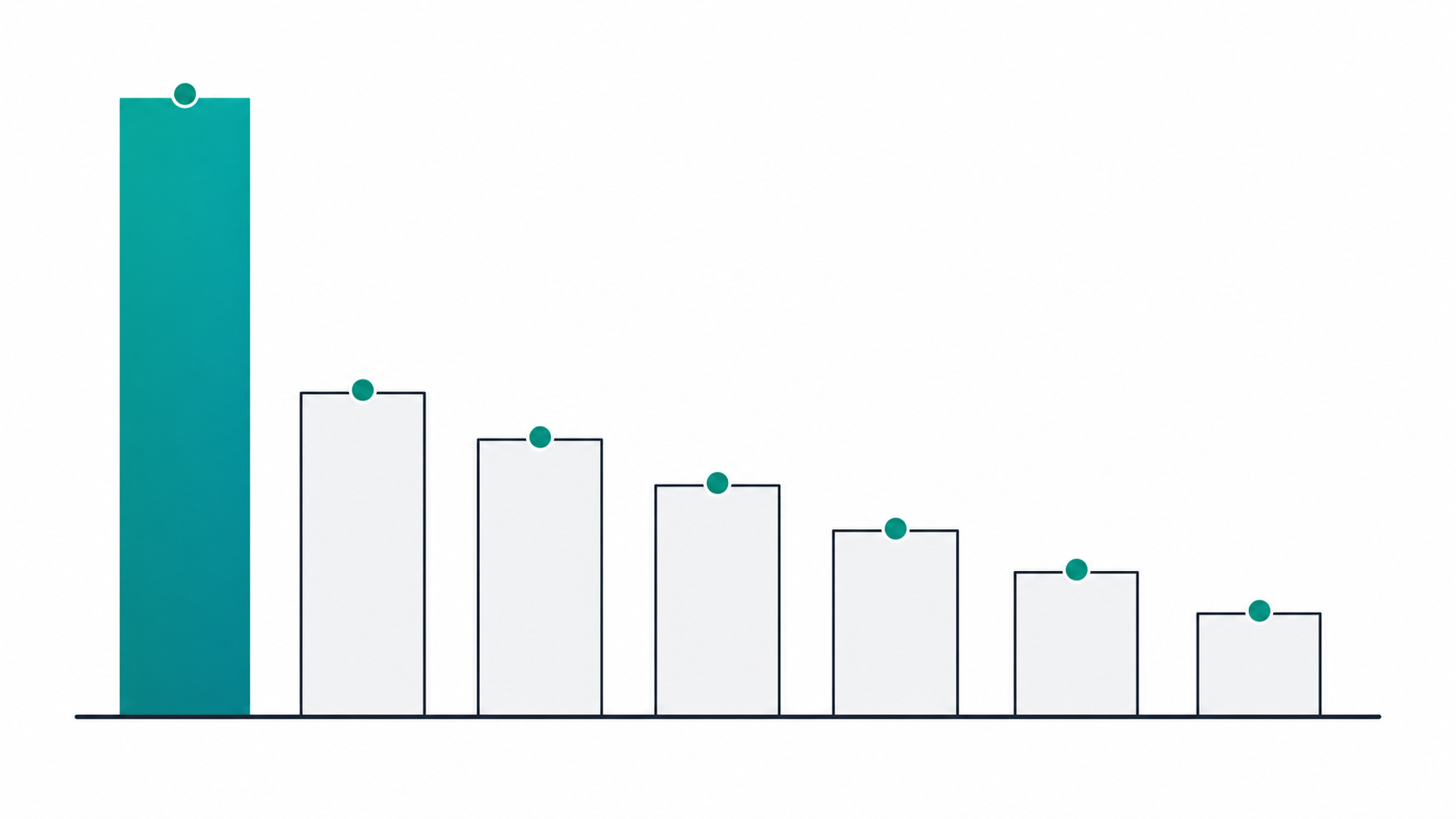
Yes, overwhelmingly. Looking at the top 100 domain sales in history tracked by NameBio, the vast majority are .com. A handful of country-code domains - .co, .io, .ai - have sold for significant sums, but none approach the top tier of .com sales.
Why .com maintains dominance:
- Consumer default: most people append .com when typing a domain from memory
- Age and trust: .com has 35+ years of brand recognition
- Email deliverability: .com email addresses face fewer spam filters
- Investor liquidity: .com domains have a deep resale market; alternatives are harder to sell
The .io exception: Tech startups normalised .io domains in the 2010s, and several sold for six figures. But .io's future is uncertain - it's the country code for the British Indian Ocean Territory, and geopolitical changes could affect the extension's long-term stability.
For most businesses, .com remains the default target. See our guide on what makes a good domain name for a full breakdown of extension strategy.
Is buying a premium domain a good investment?
It depends entirely on your definition of "investment" and your use case.
When premium domains justify their price:
- SEO arbitrage: If a domain generates organic traffic worth more annually than its purchase price amortised over a reasonable period, the economics work. insurance.com's Google Ads value made this maths tractable.
- Category defensiveness: If you're building the dominant player in a category and can afford to lock out competitors, the strategic value is real.
- Direct navigation and brand clarity: For high-traffic consumer categories, the reduced marketing spend can offset a premium purchase price over time.
When premium domains don't justify their price:
- Early-stage startups: Spending $500K on a domain before you have product-market fit is capital misallocation. That money funds product, team, and growth.
- Niche B2B businesses: If your customers find you through referrals, LinkedIn, or outbound sales, a memorable .com domain is irrelevant. Nobody types "enterprise-data-integration.com" into a browser.
- Speculative investment: Most domain investors lose money. The top 0.1% of domains capture most of the value. Buying mid-tier domains hoping for appreciation is closer to speculation than investment.
The honest answer: premium domains are a marketing asset, not a business foundation. They solve distribution problems at scale - they don't create businesses.
For most early-stage teams, how to find an available .com domain name is a more practical path than entering the premium resale market.
What can startups learn from million-dollar domain sales?

The most important lesson from the premium domain market is what it proves by contrast: brand-building works independently of domain prestige.
Consider the counter-examples:
- Stripe - stripe.com was not a $1M domain. It's a made-up word applied to payments. Stripe is now valued at ~$65B. The domain did not make Stripe; Stripe made the domain.
- Notion - notion.so (not even .com) became one of the most recognised productivity brands in tech. The .so extension, a country code for Somalia, didn't impede growth.
- Figma - figma.com was available as a brandable, invented word. No premium required.
- Slack - slack.com, a common English word with slightly negative connotations if you think about it. Didn't matter.
- Zoom - zoom.us (country code for the US) before acquiring zoom.com. Reached 300M daily meeting participants on a non-.com domain.
The pattern: Category-defining products make their domains valuable. The domain doesn't make the product category-defining.
What startups actually need from a domain:
- Memorable - can be recalled after one mention
- Spellable - no ambiguity about how to type it
- Available on .com - ideally, or on a credible alternative
- Protectable - not too close to existing trademarks
- Scalable - doesn't trap you in a niche you'll outgrow
For help finding a name that meets all five criteria, FindMyURL uses AI to generate domain names and checks real-time availability across major domain registrars, so every suggestion you see is actually available to register right now.
How do you find brandable domains without paying millions?
You don't need to buy an existing premium domain. You need to create a brand name that becomes valuable over time. Here's how to approach the search:
1. Invented words Portmanteaus, blended words, and modified dictionary terms - Spotify (spot + identify), Pinterest (pin + interest), Groupon (group + coupon). Fully ownable, trademarkable, and available.
2. Dictionary words in unexpected contexts Apple sells computers. Amazon sells everything. Stripe handles payments. Context does the work; the word itself just needs to be short and memorable.
3. Descriptive + modifier HubSpot, Salesforce, Mailchimp. Combines meaning with distinctiveness.
4. Check availability intelligently Most manual domain searches waste time on names that are taken. AI-powered domain name tools generate available options directly, cutting the search time dramatically.
5. Understand the cost landscape Before searching, read our guide on how much a domain name costs in 2026 - registering a new domain typically costs £8–£15/year, a fraction of premium resale prices.
6. Consider expired domains strategically Sometimes strong domains with brand history expire and become available at standard registration prices. Our guide on whether to buy an expired domain covers how to evaluate this.
Summary: what the $1M domain market actually tells you
| Insight | Implication |
|---|---|
| Single-word .com domains are finite | You can't find them - they're all taken |
| Premium prices reflect traffic and SEO value | Justified for category leaders at scale, not startups |
| .com dominates resale value | Target .com for long-term brand building |
| Great brands make domains valuable | Focus on product-market fit first |
| Creative names are available and cheap | Invented or unexpected-context words are the opportunity |
The million-dollar domain sales are fascinating history. They tell you what the internet's most valuable real estate looks like. But they're not a template for building your business - they're the outcome of businesses that already won.
Frequently Asked Questions
What is the most expensive domain name ever sold? Voice.com holds the record for the highest publicly confirmed single domain sale at $30 million, purchased by Block.one in 2019. Insurance.com sold for $35.6 million in 2010, which was the record at the time. Cars.com was part of a company acquisition valued at $872 million, though this includes business assets beyond the domain itself.
Why are single-word domains so valuable? Single-word .com domains are valuable because of finite supply, SEO relevance signals, direct navigation traffic, instant brand clarity for consumers, and defensive value preventing competitors from owning a category name. The combination of scarcity and commercial utility drives their price.
Is buying a premium domain a good investment? For established businesses in high-value categories, a premium domain can pay back its cost through reduced paid search spend and direct navigation traffic. For early-stage startups, premium domains are generally poor capital allocation. Most domain investors lose money, and the top fraction of domains capture most of the value. Treat premium domains as a marketing asset, not a business foundation.
How do I find out what a domain is worth? Domain valuation depends on keyword commercial value, comparable sales, direct navigation traffic estimates, length, and memorability. Automated tools provide rough estimates, but the real market value is whatever a motivated buyer will pay. For premium domains, a specialist domain broker can provide accurate appraisals.
Can I build a successful business without a premium domain? Yes. Stripe, Notion, Figma, Slack, and Zoom all built major businesses on non-premium domains. The domain name did not determine their success; product quality, distribution strategy, and timing did. A good domain needs to be memorable, spellable, and available on .com or a credible alternative. It does not need to be a dictionary word or a premium resale purchase.