{
  "@context": "https://schema.org",
  "@graph": [
    {
      "@type": "Article",
      "@id": "https://findmyurl.app/blog/trademark-vs-domain-name",
      "headline": "Trademark vs Domain Name: What Founders Get Wrong",
      "description": "Owning a domain name does not give you trademark rights, and having a trademark doesn't automatically mean you own the matching domain. This guide explains the key differences and the right order to protect your brand.",
      "url": "https://findmyurl.app/blog/trademark-vs-domain-name",
      "publisher": {
        "@type": "Organization",
        "name": "FindMyURL",
        "url": "https://findmyurl.app"
      }
    },
    {
      "@type": "FAQPage",
      "mainEntity": [
        {
          "@type": "Question",
          "name": "Does registering a domain name give you a trademark?",
          "acceptedAnswer": {
            "@type": "Answer",
            "text": "No. Registering a domain name gives you the right to use that web address, nothing more. It provides no legal protection over your brand name in commerce. Trademark rights come from either actual use in commerce or formal registration with a government trademark office."
          }
        },
        {
          "@type": "Question",
          "name": "Can someone take my domain name if they have a trademark?",
          "acceptedAnswer": {
            "@type": "Answer",
            "text": "Yes, potentially. If a trademark holder can prove your domain name infringes on their registered trademark — especially if you registered it in bad faith — they can file a UDRP (Uniform Domain-Name Dispute-Resolution Policy) complaint and have the domain transferred to them. This is why you should always check for existing trademarks before registering a domain."
          }
        },
        {
          "@type": "Question",
          "name": "How do I check if a business name is trademarked?",
          "acceptedAnswer": {
            "@type": "Answer",
            "text": "Use official government trademark databases: USPTO TESS for the United States (tmsearch.uspto.gov), WIPO Global Brand Database for international marks (wipo.int/branddb), and IP Australia for Australian trademarks (ipaustralia.gov.au). Search for your exact name, close variations, and phonetic equivalents."
          }
        },
        {
          "@type": "Question",
          "name": "Should I trademark my domain name?",
          "acceptedAnswer": {
            "@type": "Answer",
            "text": "If your domain name is also your brand name, yes. Trademarking it gives you legal exclusivity over the name in your industry category, the right to stop others from using confusingly similar names, and a stronger position in any domain dispute. Domain registration alone does not provide these protections."
          }
        },
        {
          "@type": "Question",
          "name": "What happens if someone else trademarks my domain name?",
          "acceptedAnswer": {
            "@type": "Answer",
            "text": "If someone successfully registers a trademark for a name you're using as a domain, they may be able to send a cease-and-desist letter, file a UDRP complaint to claim your domain, or sue for trademark infringement — even if you registered the domain first. This risk is highest when there's clear overlap in industry or customer base."
          }
        }
      ]
    },
    {
      "@type": "HowTo",
      "name": "How to Check Trademarks Before Registering a Domain Name",
      "step": [
        {
          "@type": "HowToStep",
          "name": "Search official trademark databases",
          "text": "Search USPTO TESS, WIPO Global Brand Database, and your country's trademark office for your proposed business name and close variations."
        },
        {
          "@type": "HowToStep",
          "name": "Generate available domain options",
          "text": "Use FindMyURL to generate domain name variations and check real-time availability across major registrars."
        },
        {
          "@type": "HowToStep",
          "name": "Register the domain immediately",
          "text": "Once you confirm the name is clear, register your domain immediately through a reputable registrar to secure it."
        },
        {
          "@type": "HowToStep",
          "name": "File your trademark application",
          "text": "File a trademark application with the relevant government office (USPTO, WIPO, IP Australia, etc.) for your brand name in the appropriate categories."
        }
      ]
    }
  ]
}
Trademark vs Domain Name: What Founders Get Wrong
Owning a domain name does not give you trademark rights, and having a trademark doesn't automatically mean you own the matching domain. They are entirely separate legal systems, governed by different bodies, offering different protections. Serious businesses need both — and the order in which you pursue them matters.

What is a domain name, and what does registering one actually give you?
A domain name is a human-readable web address — the part of a URL that points browsers to a specific server. It is part of the Domain Name System (DNS), a global technical infrastructure managed by ICANN (Internet Corporation for Assigned Names and Numbers) and administered through accredited registrars.
When you register a domain name, you are purchasing the exclusive right to use that address on the internet for the duration of your registration period (typically 1–10 years, renewable). That's it.
What domain registration does not give you:
- No legal ownership of the name as a brand
- No right to stop others from using the same name in business (only from using the same web address)
- No protection across industries or geographies
- No right to claim the name in court as intellectual property
Domain registration is first-come-first-served and takes minutes. It costs as little as $10–$20 per year.
What is a trademark, and what does it actually protect?
A trademark is a legal right granted by a government authority that gives you exclusive use of a brand name, logo, or slogan within specific commercial categories (called "classes") and geographic territories.
Trademarks are registered through national or international IP offices:
- United States: USPTO (United States Patent and Trademark Office)
- International: WIPO (World Intellectual Property Organization)
- Australia: IP Australia
- EU: EUIPO
When you own a registered trademark, you can:
- Legally prevent others from using the same or confusingly similar name in your industry
- Sue for damages if someone infringes your mark
- Use the ® symbol
- Assert rights in domain name disputes (UDRP proceedings)
- Build a legally defensible brand asset
Trademark registration takes 6–18 months and costs $250–$400 per class in the US, with additional costs for international filings.

What are the key differences between a trademark and a domain name?
| Factor | Domain Name | Trademark |
|---|---|---|
| Granted by | Accredited registrar (ICANN system) | Government IP office |
| What it protects | Your right to a specific web address | Your right to a brand name/logo in commerce |
| Registration time | Minutes | 6–18 months |
| Cost | $10–$20/year | $250–$400+ per class |
| Geographic scope | Global (one domain per TLD) | Country or region-specific |
| Duration | Annual renewal | 10 years, renewable indefinitely |
| Legal enforceability | No brand protection | Enforceable in court |
| Stops competitors using your name? | No | Yes |
What does a trademark dispute actually look like in practice?
Here's a common scenario that plays out regularly:
- Founder registers
brightpath.comand launches a consulting business - Business grows over 18 months
- A law firm sends a cease-and-desist letter — a company called BrightPath Financial registered the trademark three years ago in the financial services category
- The founder never checked trademarks before launching
- Options: rebrand entirely, negotiate a licence (expensive), or fight in court (more expensive)
Even if the two businesses are in different industries, the legal cost and disruption of a trademark dispute can be severe. The founder's domain registration provided zero protection.
This is not a rare edge case. UDRP proceedings — the formal process for domain name disputes — number in the thousands per year globally.

How do I check if a business name is already trademarked?
Before registering any domain name or committing to a brand name, search these official databases:
United States Search the USPTO's trademark database at tmsearch.uspto.gov. Use the "Basic Word Mark Search" for initial screening. Search your exact name, then phonetic variations (e.g. "Klear" for "Clear").
International The WIPO Global Brand Database covers marks registered in dozens of countries through the Madrid System. Essential if you plan to operate internationally.
Australia Search IP Australia's trademark register for marks registered in Australia.
What to search for:
- Your exact proposed name
- Phonetically similar names
- Visually similar names (e.g. abbreviations, misspellings)
- Names in the same or adjacent industry classes
Important: These searches are not a substitute for professional legal advice. A trademark attorney can identify risks that are not obvious from a basic text search, including common law marks (unregistered but legally recognised through use).
What is the right order: trademark first or domain first?
Neither system waits for the other, but the recommended sequence minimises risk:
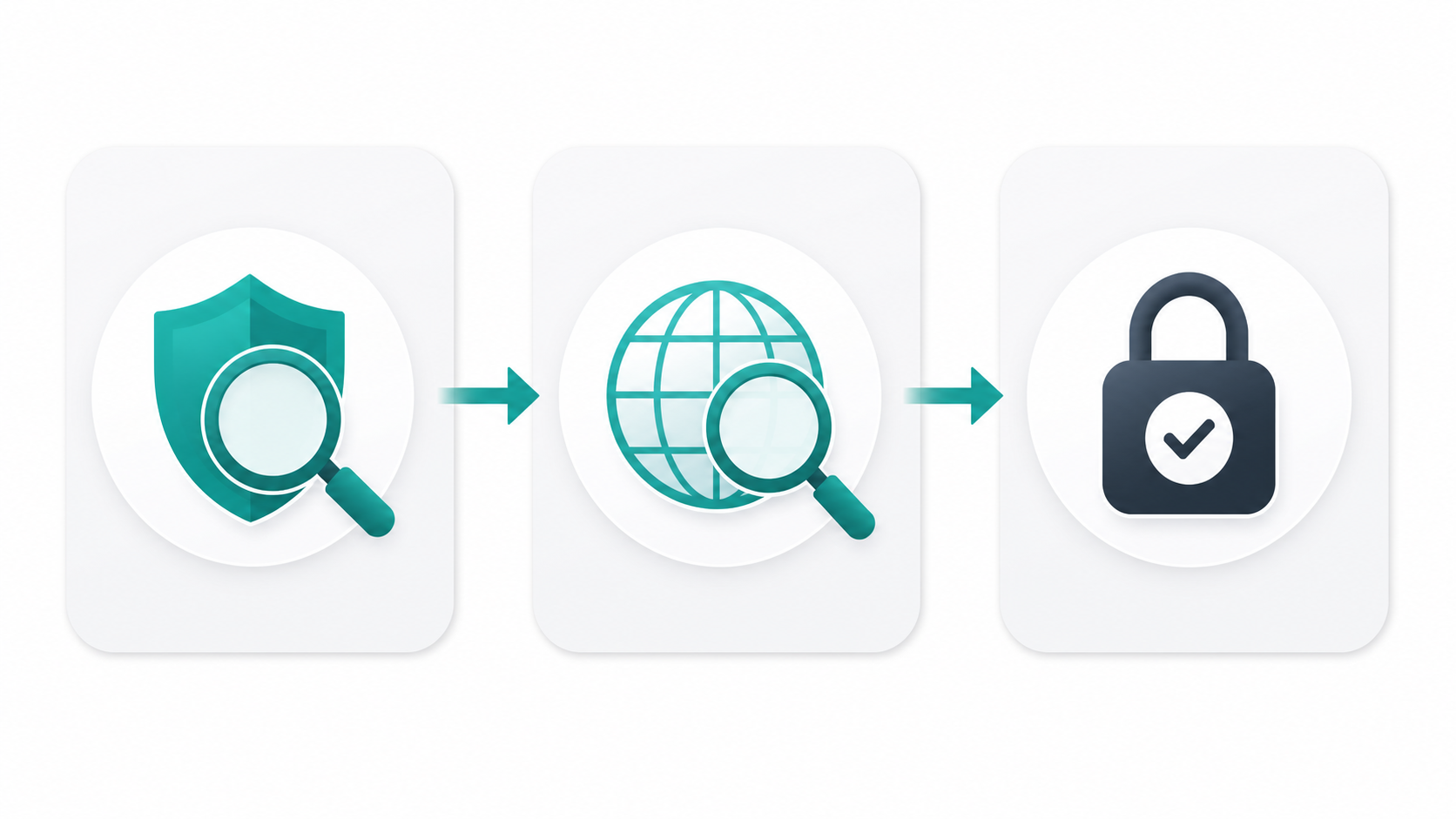
Step 1 — Search existing trademarks
Before anything else, search the databases above. If your name is already trademarked in your industry, find out now before you invest in a domain, branding, or marketing.
Step 2 — Generate and check domain availability
Once you have a name that appears clear of existing trademarks, check domain availability. The .com may be taken even if the trademark is clear — you may need to iterate on variations.
FindMyURL uses AI to generate domain names and checks real-time availability across major domain registrars, so every suggestion you see is actually available to register right now.
This is far faster than manually searching registrar after registrar. You can also explore extensions (.io, .co, .app) or creative variations while keeping your core brand intact.
See also: How to find the perfect domain name for your startup and How to come up with a business name for naming strategies before you search.
Step 3 — Register the domain immediately
Once you find an available domain that fits, register it immediately. Domain availability changes quickly. Do not wait until your trademark is approved — that could be 12+ months.
Be aware of domain front-running — the practice of registrars or third parties snapping up domains after you search for them. Use registrars with strong privacy policies, and register promptly.
Step 4 — File your trademark application
With the domain secured, engage a trademark attorney and file your trademark application. In the US, you can file based on "intent to use" — you do not need to be trading yet.
Common mistakes at this stage are covered in The 10 most common domain name mistakes.
Do I need a trademark if I'm just a small business or early-stage startup?
You do not legally need one, but the risk of not having one scales with how much you invest in your brand. Consider:
- If your business grows, your brand name becomes more valuable — and more worth attacking or imitating
- Investors often ask about trademark status during due diligence
- Domain disputes are won or lost largely on trademark status
- Competitors in your space may file first if you delay
The practical answer: trademark costs are relatively small compared to the cost of rebranding after a dispute. File early, even if you are pre-revenue.
Frequently Asked Questions
Does registering a domain name give you a trademark?
No. Registering a domain name gives you the right to use that web address, nothing more. It provides no legal protection over your brand name in commerce. Trademark rights come from either actual use in commerce or formal registration with a government trademark office.
Can someone take my domain name if they have a trademark?
Yes, potentially. If a trademark holder can prove your domain name infringes on their registered trademark — especially if you registered it in bad faith — they can file a UDRP complaint and have the domain transferred to them. This is why you should always check for existing trademarks before registering a domain.
How do I check if a business name is trademarked?
Use official government trademark databases: USPTO TESS for the United States, the WIPO Global Brand Database for international marks, and IP Australia for Australian trademarks. Search for your exact name, close variations, and phonetic equivalents.
Should I trademark my domain name?
If your domain name is also your brand name, yes. Trademarking it gives you legal exclusivity over the name in your industry category, the right to stop others from using confusingly similar names, and a stronger position in any domain dispute. Domain registration alone does not provide these protections.
What happens if someone else trademarks my domain name?
If someone successfully registers a trademark for a name you're using as a domain, they may be able to send a cease-and-desist letter, file a UDRP complaint to claim your domain, or sue for trademark infringement — even if you registered the domain first. This risk is highest when there is clear overlap in industry or customer base.
Ready to find a domain that's actually available? Search on FindMyURL →