For an online store, a short, brandable .com domain is the strongest choice - shoppers are wary of unfamiliar extensions when entering payment details, and trust is your most valuable conversion asset. Focus on a brand name rather than an exact-match product keyword, keep it under 15 characters, and make it easy to spell when heard aloud. FindMyURL can generate ecommerce-specific domain ideas based on your products and target audience, with real-time availability so you can register immediately.
Why does domain choice matter more for ecommerce than other websites?
Every website needs a good domain. But for an online store, the stakes are higher because your domain is part of the trust chain that convinces a stranger to hand over their card details.
A confusing, misspelled, or unfamiliar domain name is a silent conversion killer. It shows up in:
- Browser address bars - customers glance at the URL before checkout
- Email receipts and shipping confirmations - your domain appears repeatedly post-purchase
- Word-of-mouth - if someone can't remember or spell your domain, you lose the referral
- Social proof - a professional domain signals an established, legitimate business
The domain you choose today will appear on every invoice, every marketing campaign, and every Google result for your brand. Getting it right matters more than almost any other early decision.
Is .com really that important for an online store?
Yes - and for ecommerce specifically, more so than almost any other type of website.
Shoppers have been conditioned over decades to associate .com with legitimate businesses. When a customer reaches your checkout page, they are making a split-second trust decision. An unfamiliar TLD - even a credible one like .shop or .store - introduces doubt at the worst possible moment.
What the data suggests:
.comdomains receive higher click-through rates in search results- Customers are more likely to type
.comby default when returning to a store - Payment processors, shipping partners, and email deliverability services all treat
.comaddresses as higher-trust
When alternatives can work:
.co- widely recognised, acceptable for modern brands.shop/.store- clear ecommerce signals, acceptable if the brand is strong enough- Country-code TLDs (
.co.uk,.com.au) - appropriate if you serve a single geographic market
If the .com version of your preferred name is taken, the better option is usually to modify the brand name until you find an available .com - not to settle for a different extension. See our guide on which domain extension should I choose? for a full breakdown.
Should I use keywords or a brand name in my ecommerce domain?
Use a brand name. This is one of the most common mistakes new store owners make.
Exact-match keyword domains like cheapleatherwatches.com or buyproteinpowderonline.com have three significant problems:
- They limit your catalogue. If you expand into new products, your domain becomes misleading or outdated.
- They look untrustworthy. Keyword-stuffed domains are associated with low-quality affiliate sites and drop-shippers.
- They no longer rank better. Google's ranking systems have de-weighted exact-match domain bonuses in favour of brand authority, backlinks, and content quality.
Effective ecommerce naming strategies:
| Strategy | Example | Why it works |
|---|---|---|
| Invented word | Zappos, Glossier | Unique, protectable, memorable |
| Category + modifier | PureLeaf, BoldRoast | Suggests the niche without locking you in |
| Lifestyle / aspiration | Allbirds, Patagonia | Builds emotional connection |
| Founder name | Warby Parker, Kylie Cosmetics | Authentic, trust-building |
| Portmanteau | Pinterest, Groupon | Short, distinctive, brandable |
The best ecommerce brand names are short (under 15 characters), easy to spell when heard, unique enough to trademark, and not dependent on a specific product.
For more on the fundamentals, read what makes a good domain name?
How does my domain name affect my online store's SEO?
Your domain name has indirect but real SEO implications - though not in the way most people assume.
What your domain no longer does: Exact-match keyword domains used to pass a meaningful ranking signal to Google. That advantage has largely disappeared. Google's own search documentation does not list keyword-rich domain names as a ranking factor, and their systems now heavily weight brand authority built over time.
What your domain still does:
- Affects click-through rate - a recognisable brand name in search results earns more clicks than a generic keyword string
- Influences anchor text - sites that link to you often use your domain name as the anchor, so a branded domain builds cleaner link profiles
- Determines your email domain -
support@brandname.comsignals legitimacy to spam filters, improving deliverability of transactional emails - Sets your URL structure - a clean domain makes for cleaner product URLs, which are a minor on-page factor
The SEO advice is consistent with the branding advice: build a strong brand name on a .com, invest in content and backlinks, and Google will reward brand authority far more than keyword placement in your domain.
What are the best strategies for naming an ecommerce store?
Here are five proven approaches used by successful online stores:
1. Product category + modifier
Combine a product category word with a descriptor that adds personality or positioning.
FreshLeaf(tea)BoldBrew(coffee)CleanCut(grooming)
Avoid making this too literal - CheapTea.com is a trap. The modifier should evoke quality or lifestyle, not price.
2. Invented or abstract brand name
Completely made-up words are the gold standard for trademark protection and memorability.
- Etsy, Zara, Vans - none of these describe a product
- Easier to register as a trademark
- Higher creative ceiling for brand storytelling
3. Lifestyle or aspirational name
Name the outcome or identity your customer wants, not the product.
- Allbirds (comfort, nature)
- Gymshark (performance, identity)
- Bombas (quality, mission)
4. Founder name
Founder-named brands carry authenticity and authority. This works particularly well for artisan goods, fashion, and beauty.
- Works best when the founder has a distinctive or memorable name
- Builds a personal trust narrative
- Can become limiting if the business is sold
5. Portmanteau or blend
Combine two relevant words into one short coinage.
Luxique(luxury + boutique)Farmly(farm + family)Boldish(bold + stylish)
For startup-specific naming advice, see how to find the perfect domain name for your startup.
How do I find an available ecommerce domain name right now?
The challenge with ecommerce domains is that millions of .com names are already registered - including many that are parked and unused. The key is finding names that are genuinely available, not ones that redirect you to a broker charging thousands of dollars.
FindMyURL uses AI to generate domain names and checks real-time availability across major domain registrars, so every suggestion you see is actually available to register right now.
How to use FindMyURL for your online store:
- Go to findmyurl.app
- Describe your store - your product category, target customer, and brand tone
- Review AI-generated name suggestions with instant availability status
- Register directly with your preferred registrar
This eliminates the frustrating loop of manually checking names one by one, only to find each one taken. Every name surfaced is registerable immediately.
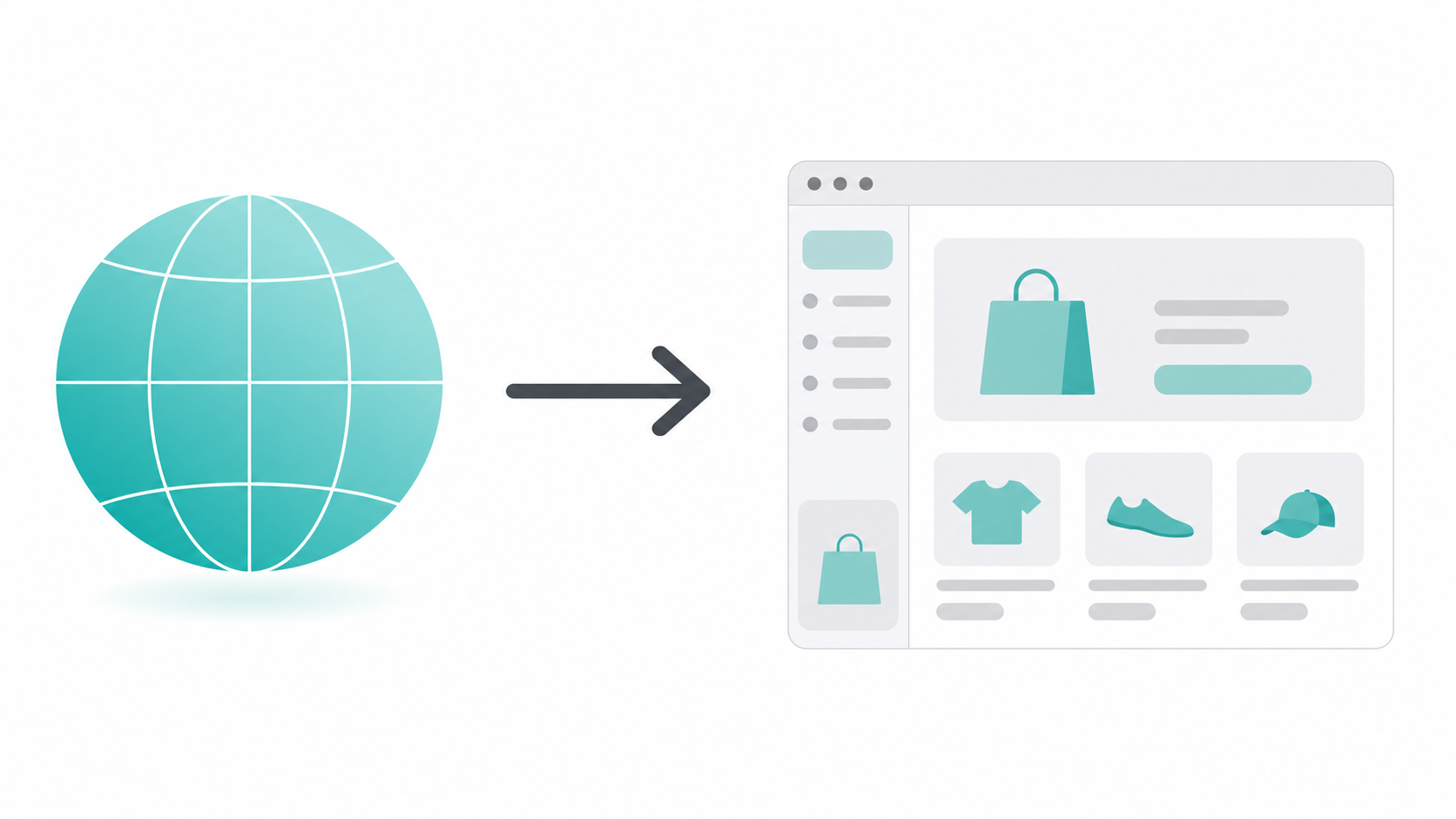
How do I connect a custom domain to Shopify, WooCommerce, or BigCommerce?
Once you have purchased your domain, connecting it to your ecommerce platform is a straightforward DNS configuration.
Connecting to Shopify
- In your Shopify admin, go to Settings → Domains
- Click Connect existing domain
- Enter your domain name and follow Shopify's verification steps
- Log in to your registrar and update your DNS records:
- Point the A record to Shopify's IP:
23.227.38.65 - Add a CNAME record for
wwwpointing toshops.myshopify.com
- Point the A record to Shopify's IP:
- DNS propagation takes between 30 minutes and 48 hours
Full instructions are available at Shopify's custom domains documentation.
Connecting to WooCommerce
WooCommerce runs on WordPress, so your domain connects at the hosting level:
- Purchase a hosting plan (e.g., SiteGround, Kinsta, WP Engine)
- Point your domain's nameservers to your host's nameservers
- WordPress and WooCommerce will serve from that domain automatically
Connecting to BigCommerce
- In BigCommerce admin, go to Store Setup → Domain Name
- Choose Use a domain I already own
- Update your registrar's DNS to point to BigCommerce's servers (provided in the setup flow)
For a full walkthrough of buying and transferring domains, read how to buy a domain name.
How much should I spend on an ecommerce domain name?
New, unregistered domains typically cost $10–$20 per year through registrars like Namecheap, GoDaddy, or Google Domains.
If your preferred name is already registered, you may be able to purchase it on the aftermarket. Prices vary enormously:
- $100–$2,000 - common for standard one-word or two-word
.comdomains - $5,000–$50,000+ - premium short domains or exact-match category terms
- Six or seven figures - ultra-premium generic domains (rare, not necessary for most stores)
For most new online stores, the right answer is to use FindMyURL to find a creative brand name that's available as a new registration - and invest the saved budget into products, marketing, and customer experience instead.
For a full cost breakdown, see how much does a domain name cost in 2026?
Quick reference: ecommerce domain checklist
Before registering your online store domain, confirm it meets these criteria:
-
.comextension (strongly preferred) - 6–15 characters
- No hyphens or numbers
- Easy to spell when spoken aloud
- Not trademarked by another business
- Brand name, not a keyword string
- Available to register as a new domain (not aftermarket)
- Matching social media handles available (check before registering)
- No negative connotations in target markets
Frequently asked questions
What is the best domain name for an online store?
The best ecommerce domain is a short, brandable .com that is easy to spell, easy to remember, and not tied to a single product category. Avoid hyphens, numbers, and generic-sounding names that erode customer trust.
Should my store domain include my product name? Not necessarily. Exact-match product domains limit your ability to expand your catalogue and can appear untrustworthy. A brand name gives you flexibility and performs better long-term with Google's authority-based ranking signals.
Is .com important for ecommerce?
Yes - more so than for almost any other website type. Shoppers are conditioned to trust .com when entering payment details. Alternative TLDs like .shop or .store introduce trust friction at checkout that can directly reduce conversion rates.
How do I connect a custom domain to Shopify?
In Shopify admin, go to Settings → Domains → Connect existing domain. Enter your domain, then update your registrar's DNS records - an A record pointing to 23.227.38.65 and a CNAME for www pointing to shops.myshopify.com. Changes typically propagate within a few hours.
Does my domain name affect online store SEO? Indirectly, yes. Keyword domains no longer provide a meaningful ranking boost. Google now prioritises brand authority, backlinks, and content quality. A memorable brand domain that earns links and repeat visits will outperform a keyword-stuffed domain over time.