How to Find a Domain Name for Your Blog
The best blogs use domains that are either strongly topic-specific (minimalistbaker.com) or strongly personality-driven (waitbutwhy.com) — not generic or vague. Choose a name you can grow into, that works spoken aloud, and that you'll still be happy with in five years. Use FindMyURL to generate creative, available blog name ideas based on your topic and writing style.
What makes a blog domain name different from any other domain?
A blog name carries more weight than most business domains. It needs to signal a voice, not just a subject. It's often the first thing a reader hears — mentioned in a podcast, typed into a phone, shared by a friend — so it has to stick immediately.
The fundamental tension in blog naming is this: be specific enough to attract the right readers, but broad enough to give yourself room to grow. Get that balance wrong and you'll either outgrow your domain in two years or struggle to attract anyone at all.
A few principles that separate great blog domains from forgettable ones:
- Distinct, not descriptive. "HealthTipsDaily.com" tells you what the blog covers. "WaitButWhy.com" makes you curious. Curiosity wins.
- Speakable. If you can't say your domain clearly on a podcast without spelling it out, reconsider it.
- Memorable in isolation. The best blog names work even when you forget the URL — you can reconstruct it from memory.
- Not a placeholder. Register the name you actually want, not the name you settled for.
For a deeper look at what separates good domains from great ones across all categories, see What makes a good domain name?
Niche blog, personal blog, or aggregator blog — does the type change the naming strategy?
Yes, significantly. These are three distinct content models and each has a different naming logic.
Niche blogs
A niche blog has a defined subject: sourdough baking, van life, TypeScript tutorials, personal finance for freelancers. The domain should signal the niche — but signal it with personality, not with keywords.
Works well:
- MinimalistBaker.com — the niche is baking, the "minimalist" angle differentiates
- TheSkimm.com — news and current events, with a personality-driven twist
- MarkManson.net — personal development, anchored to a name with a clear POV
Avoid:
- BakingTipsAndRecipes.com — keyword-stuffed, forgettable
- VanLifeBlog.net — generic, no personality, weak extension
Personal blogs
Personal blogs are built around a writer's voice rather than a single subject. These almost always work best with a name-based domain or a coined phrase that represents the writer's worldview.
The risk is scope creep: your personal blog drifts from travel to parenting to career advice. A name-based domain survives that drift. A topic-based domain doesn't.
If you're building a personal brand alongside your blog, read Should you use your own name as your domain? before committing.
Aggregator blogs
Aggregator blogs curate content from elsewhere — link roundups, reading lists, weekly digests. These often work with collective or editorial-feeling names: "The Browser," "Kottke," "Arts & Letters Daily." They tend to feel more like publications than personal sites, so brand-style names (coined, editorial, slightly abstract) perform well.
Why should blog names be distinct rather than descriptive?
Descriptive blog names — ones that literally explain the content — have a built-in ceiling. They attract readers who already know they want that thing, but they rarely generate word-of-mouth. Nobody says "have you heard of HealthAndWellnessBlog.com?" They say "have you read Brain Pickings?"
The blogs that build lasting audiences tend to have names that do one of three things:
- Create curiosity — WaitButWhy implies there's a reason to pause and think differently. You want to know what the "why" is.
- Communicate a distinctive angle — The Minimalists isn't about minimalism as a topic, it's a statement of identity and philosophy.
- Anchor to an unforgettable voice — Kottke.org is just a surname. But after two decades, that name is the blog.
Descriptive names also cause SEO confusion. If your blog is called "FitnessAdviceForWomen.com," Google can't easily distinguish your brand from the generic phrase. A distinctive name builds brand equity that compounds over time.
How do you future-proof a blog domain name?
The most common blog naming mistake is over-specificity. You start a blog about running half marathons and name it HalfMarathonTraining.com. Two years later you're writing about trail running, nutrition, and travel. Now you're trapped.
Before registering, ask yourself:
- If I expand this blog into a podcast, a course, or a book — does this name still work?
- If my subject focus shifts by 30%, does the domain become misleading?
- Would I be comfortable with this name on a book cover or in a podcast bio?
- Will this name feel dated in five years? (Avoid trendy words, platform references, or time-specific language)
Strategies that future-proof a blog name:
- Use your name — anchors the brand to you, not the topic
- Coin a concept — Brain Pickings works whether Maria Popova writes about books, art, science, or philosophy
- Find an evocative metaphor — something that captures your approach rather than your subject
- Use abstract but resonant words — "signal," "margin," "dispatch," "commonplace" can work across many content types
See The anatomy of a perfect .com for a detailed breakdown of what structural features make domain names durable.
What are the best domain name patterns for blogs?
Multi-word blog domains are the norm, not the exception. Unlike startups, blogs rarely need single-word brandable names. Here are the patterns that work consistently:
[Adjective] + [Noun]
- MinimalistBaker
- BraveGirlsClub
- SmallFootprintFamily
Works when the adjective signals your distinctive angle on the topic.
[The] + [Concept]
- TheBrowser
- TheSkimm
- TheOutline
Gives a publication-style feel. Good for aggregators and editorial voices.
[Name] + [Optional word]
- MarkManson.net
- Kottke.org
- AustinKleon.com
Clean, authoritative, and infinitely flexible.
[Verb phrase or question]
- WaitButWhy
- DoYouYoga
- MakeItDo
Evokes action or curiosity. Tends to feel energetic and reader-directed.
Coined word or portmanteau
- Lifehacker
- Treehugger
- Copyblogger
High risk, high reward. Hard to discover organically but incredibly sticky once known.
General pattern rules:
- Two to four words is the sweet spot for blog domains
- Avoid hyphens — they break up spoken versions and look amateur
- Avoid numbers unless they're core to your brand concept
- .com is still the default expectation for most readers
Should you use a subdomain or a standalone custom domain for your blog?
This is one of the most common structural questions bloggers face: yourname.com/blog versus yourblog.com.
The answer depends entirely on what the blog is for.
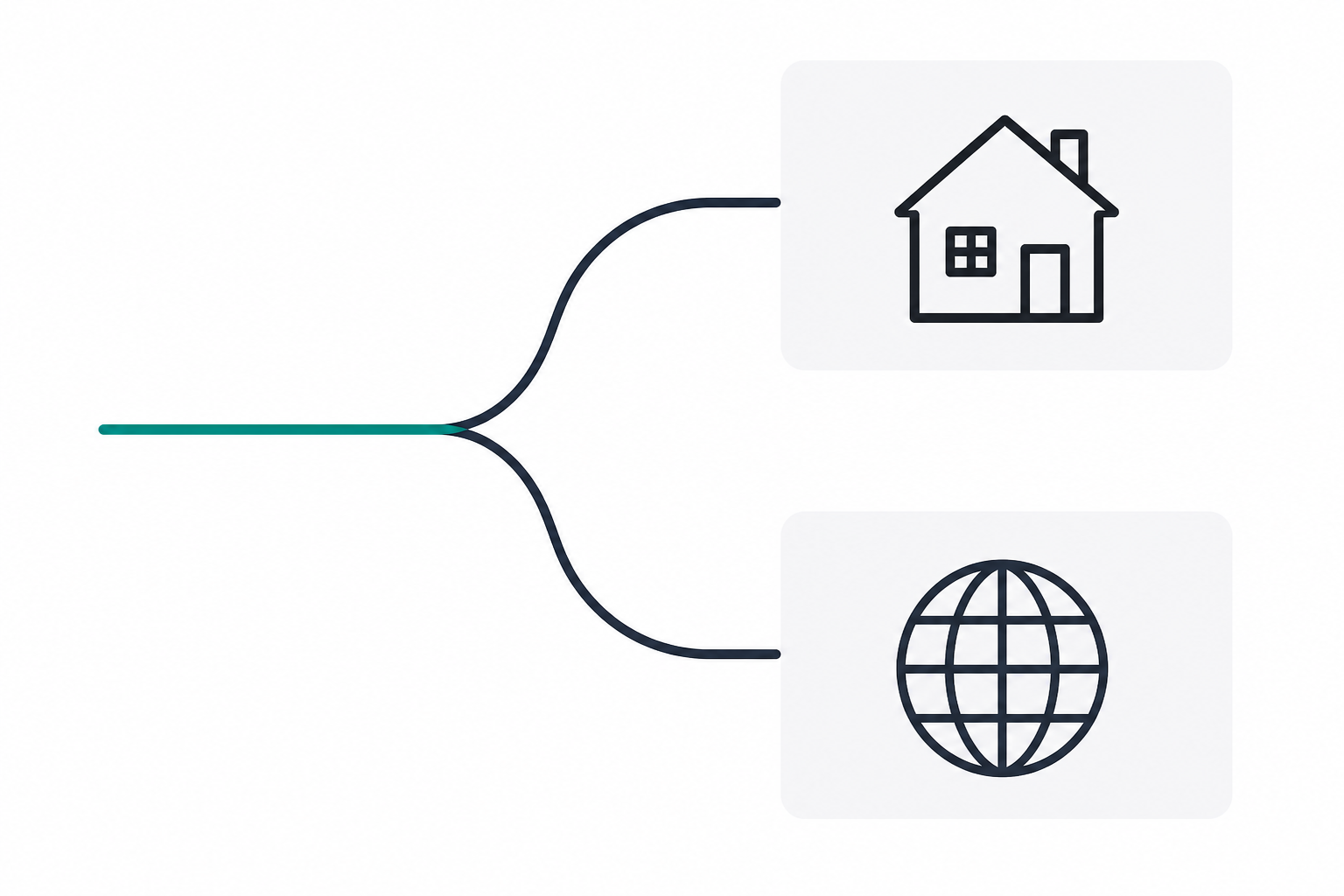
Use yourname.com/blog when:
- Your blog supports a primary business or portfolio site
- You want all SEO authority concentrated on one domain
- The blog is one part of a larger personal or professional brand
- You're a consultant, designer, developer, or speaker using content to drive leads
Example: A freelance UX designer at sarahjohnson.com who writes about design systems. The blog at sarahjohnson.com/blog builds her authority without splitting her brand.
Use a standalone blog domain when:
- The blog is the primary brand — not a supporting element
- You want the freedom to build a distinct publication identity
- You're building toward monetisation through ads, memberships, or products under that brand
- You want to sell or license the blog independently someday
Example: WaitButWhy exists as its own brand. Tim Urban could write under timurban.com/blog, but "WaitButWhy" has become a cultural entity independent of his name.
What about yourname.substack.com or yourname.ghost.io?
Free platform subdomains — on Substack, Ghost, or WordPress.com — are fine for starting out. They remove technical friction and let you focus on writing. But they have real limitations:
- You don't own the address — if the platform changes, your URL changes
- SEO authority builds on the platform's domain, not yours
- It signals "I haven't committed to this yet" to potential sponsors or collaborators
- Migration later is messy
The recommendation: start on a free platform if you need to, but set up a custom domain from day one. Most platforms support custom domains for a small monthly fee, and the long-term brand equity is worth it.
Does blogging on your own domain actually affect your authority and SEO?
Yes — significantly, and over time the gap widens.
When you publish consistently on a custom domain, you build:
- Domain authority — the cumulative trust Google assigns to your domain based on age, backlinks, and content quality
- Brand recognition — readers remember and return to a named destination, not a platform URL
- Email and social coherence — your domain anchors your whole identity (hi@yourblog.com, not yourblog.substack.com)
- Portability — you can change platforms without losing your audience's access point
Blogs that started on free platforms and migrated to custom domains typically see a temporary SEO dip during migration. Those that started on custom domains from the beginning compound their authority without interruption.
For long-term audience building, a custom domain isn't optional — it's the foundation. Platforms like Ghost and WordPress.org make it straightforward to host a professional blog on your own domain from day one.
What do iconic blog names have in common — and what can you learn from them?
Three blog names that became genuinely cultural: WaitButWhy, The Minimalists, and Brain Pickings. Here's what they get right.
WaitButWhy (waitbutwhy.com)
- What it does: Creates immediate curiosity and implies a contrarian, slow-thinking approach
- What it avoids: Any specific topic reference — Tim Urban writes about AI, relationships, history, and human psychology
- Why it works: The name is the editorial philosophy. "Wait" implies pause and reconsideration. "But why?" implies first-principles thinking. You understand the blog's soul from the name alone.
The Minimalists (theminimalists.com)
- What it does: Names the identity, not the subject. Minimalism is a lens, not a topic.
- What it avoids: "MinimalistLiving.com" or anything that sounds like a how-to resource
- Why it works: "The Minimalists" is plural and tribal — it implies a community of people with shared values, not just one writer giving advice. That framing built an audience that identified as minimalists.
Brain Pickings (brainpickings.org)
- What it does: Captures the act of reading and extracting meaning — the blog is literally about "picking" through ideas
- What it avoids: Any genre label (literature blog, philosophy blog, culture blog)
- Why it works: The metaphor is precise without being limiting. Maria Popova later renamed it The Marginalian — but Brain Pickings proved the concept works for fifteen years across dozens of subjects.
The common thread: All three names describe how the writer thinks, not what they write about. That's the principle worth internalising.
How do you find an available domain name for your blog?
The traditional approach — typing names into a registrar and hitting "check" — is slow, demoralising, and produces no creative momentum. Most obvious names are taken. The registrar then suggests "yourblog123.net" and you lose the will to continue.
A better workflow:
- Start with concepts, not names. Write down five words that describe your editorial voice. Five words that describe your subject. Five words that describe how you want readers to feel.
- Generate combinations. Use those words to produce multi-word phrases, metaphors, and compound words. Aim for 30–40 candidates before checking availability.
- Filter for distinctiveness. Remove anything that sounds generic, keyword-heavy, or too similar to an existing publication.
- Check availability in bulk. Don't check one at a time — check your whole shortlist at once.
FindMyURL uses AI to generate domain names and checks real-time availability across major domain registrars, so every suggestion you see is actually available to register right now.
That means you can describe your blog's voice and subject in plain language — "a conversational blog about slow living and intentional consumption for urban professionals" — and get back a list of available, creative domains that actually fit. No guessing. No rejected searches. No settling.
→ Generate blog domain name ideas at FindMyURL
For more on the newsletter-adjacent blog naming approach, see How to find a domain name for your blog or newsletter.
Frequently Asked Questions
What should I name my blog? Name your blog based on your editorial voice and approach, not just your subject. The strongest blog names describe how you think rather than what you cover — like WaitButWhy or Brain Pickings. Aim for a name that is distinct, speakable, memorable, and broad enough to accommodate your future direction. Avoid generic descriptive names that could apply to dozens of blogs in your niche.
Is it better to use my name or a topic name for my blog domain? It depends on the blog's purpose. Use your name if you're building a personal brand and your blog will cover multiple subjects or support a broader professional identity. Use a topic-based or concept-based name if you're building a standalone publication with its own identity. Personal name domains are more future-proof; concept-based domains can build stronger community identity around a specific idea.
How do I find an available domain name for my blog? Start by generating a large list of name concepts based on your editorial voice, subject, and the feeling you want to create. Then check availability in bulk rather than one at a time. Tools like FindMyURL use AI to generate creative blog domain ideas and check real-time availability across registrars, so every suggestion shown is immediately registrable.
What domain extension should my blog use? .com remains the default expectation for most readers and is the strongest choice for blog authority and memorability. If .com is unavailable, .net or .org are credible alternatives — .org works particularly well for editorial or non-commercial blogs. Avoid obscure extensions unless they form a clever, memorable combination with your blog name.
Should I start a blog on a free platform or my own domain? Free platforms like Substack or WordPress.com are fine for early experimentation, but a custom domain is worth setting up from day one. It builds domain authority that compounds over time, makes migration easier later, and signals commitment to readers, sponsors, and collaborators. Most blogging platforms — including Ghost and WordPress.org — support custom domains with minimal setup.